Plumbing Repair vs Replace: A Friendswood, TX Homeowner's Guide
Water heaters, pipes, sewer lines, toilets, and slab leaks: when a repair is smart money and when replacement saves you more in the long run.
- 50% rule of thumbRepair cost vs replacement
- Friendswood focused77546 and 77549
- Local factorsClay soil, hard water
- Honest guidanceNo pressure
- Real price rangesTypical national costs
The question every homeowner faces eventually
Something in your plumbing system fails. The plumber finds the problem. Then comes the question that stalls more decisions than any other in home repair: should you fix what you have, or replace it? It sounds simple, but the right answer depends on the age of the equipment, the cost of the fix, how the local environment wears things down, and what the next five years probably look like for that part of your system.
Here in Friendswood, the local environment matters more than most homeowners realize. Our expansive clay soil moves with the seasons, which is hard on slab foundations and the pipes beneath them. Gulf Coast hard water shortens the life of water heaters and scale-sensitive fixtures. Many homes in 77546 were built in the 1960s through the 1980s, an era when galvanized steel supply lines were standard, and those lines are now decades past their best years. All of this tilts the repair-or-replace math in ways that generic national advice does not always capture.
This guide walks through the five most common repair-versus-replace decisions Friendswood homeowners face, with typical national cost ranges so you can sanity-check any quote. Prices given here are national industry ranges, not our prices; every home is different, and the final number depends on what is actually in your walls and under your slab.
A simple framework to start with: compare the cost of the repair against the cost of replacement. If a repair costs more than half of what replacement would cost, and the equipment is more than about two-thirds through its expected lifespan, replacement is usually the better financial move. This is not a law, just a starting point. The sections below add the local nuance that the simple rule misses.
Water heater: repair or replace?
Water heater decisions are the most common repair-or-replace question in Friendswood, and one of the easiest to get right once you know two facts: the age of the tank, and the cost of the fix.
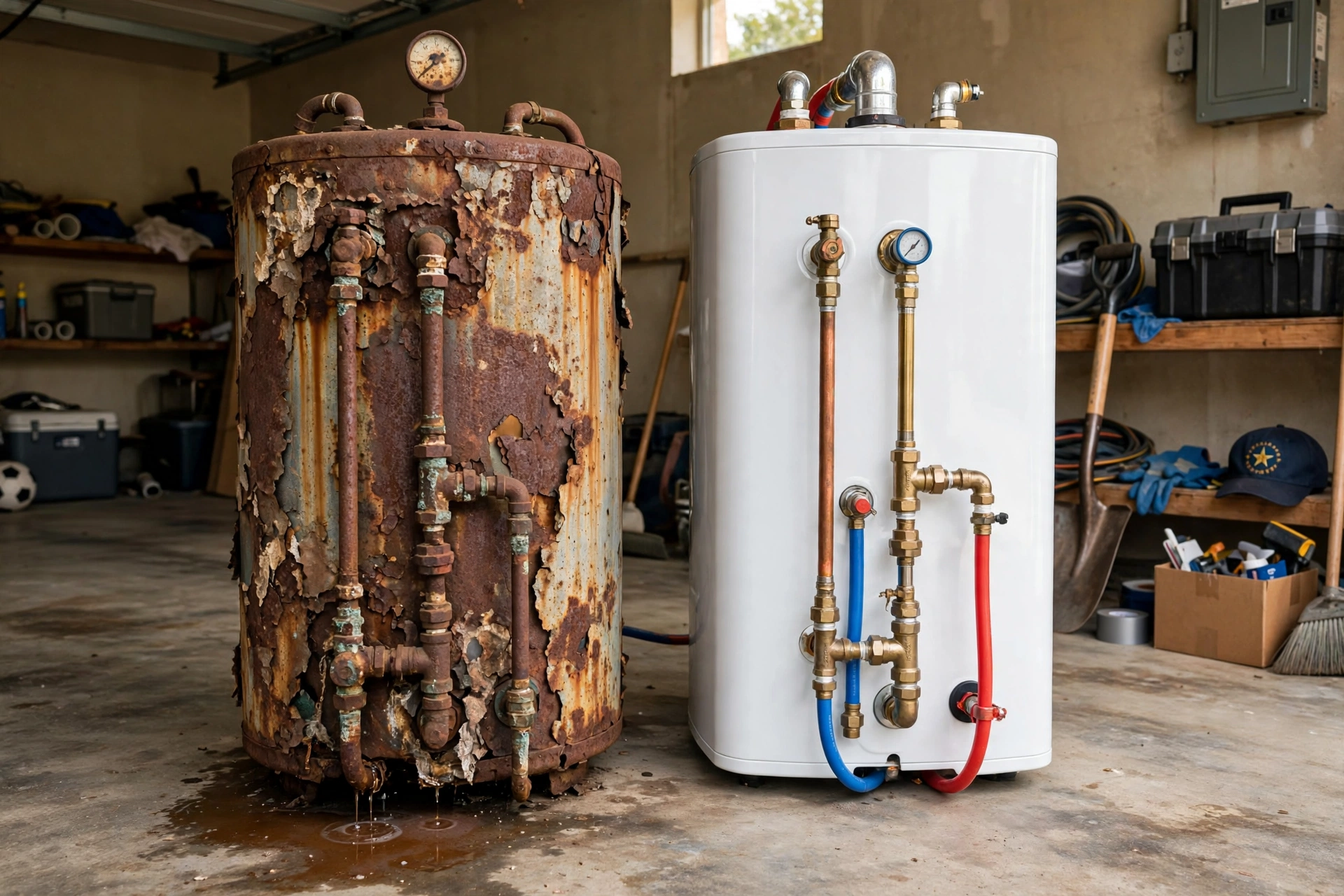
A standard tank water heater lasts roughly 8 to 12 years, and hard water areas like ours tend toward the lower end of that range. The U.S. Department of Energy notes that sediment buildup from mineral-heavy water reduces efficiency and shortens tank life, which is why flushing the tank yearly matters so much in the Houston metro area. Tankless units last longer, often 15 to 20 years with proper descaling, but they cost substantially more upfront.
Repairs that usually make sense: a failed thermostat or heating element, a worn thermocouple on a gas unit, a leaky temperature-and-pressure relief valve, or a corroded anode rod that can still be replaced. These are component-level fixes, typically in the low hundreds of dollars nationally, and they restore a young tank to full service.
Signs that replacement is the better call: the tank itself is leaking (a leaking tank cannot be repaired; corrosion through the tank wall is terminal), rusty or metallic-smelling hot water that returns soon after flushing, rumbling or popping sounds from heavy sediment buildup that flushing no longer clears, or a unit that is past year 10 and needs its second major repair. Nationally, a standard 40 to 50 gallon gas or electric tank runs about $900 to $1,800 installed, while a whole-home tankless unit typically runs $2,500 to $4,500 or more installed, depending on gas line and venting needs.
Tankless units deserve a separate note because the math differs. A tankless heater costs two to three times what a standard tank costs installed, but it eliminates standby heat loss and typically lasts 15 to 20 years when descaled on schedule. In our hard water area, that descaling is not optional; mineral buildup on the heat exchanger is the number one killer of tankless units on the Gulf Coast. If your gas line or electrical panel needs upgrading to support a tankless unit, factor that into the comparison before you fall in love with the endless-hot-water promise.
Real talk: a $300 repair on an 11-year-old tank buys you borrowed time, not a new water heater. Plan the replacement on your schedule rather than waiting for a rupture.
One Friendswood-specific note: garage-installed heaters are the norm here, and many older garages lack a drain pan or proper strapping. When you do replace, it is worth asking about a pan with a drain line and a new expansion tank, small add-ons that prevent large problems later. For a full breakdown of what is included in a standard installation, see our water heater repair page.
Spot pipe repair vs whole-home repiping
Few decisions change a home more than repiping. It is disruptive, it is not cheap, and it solves a whole category of problems at once. So when is a spot repair enough?
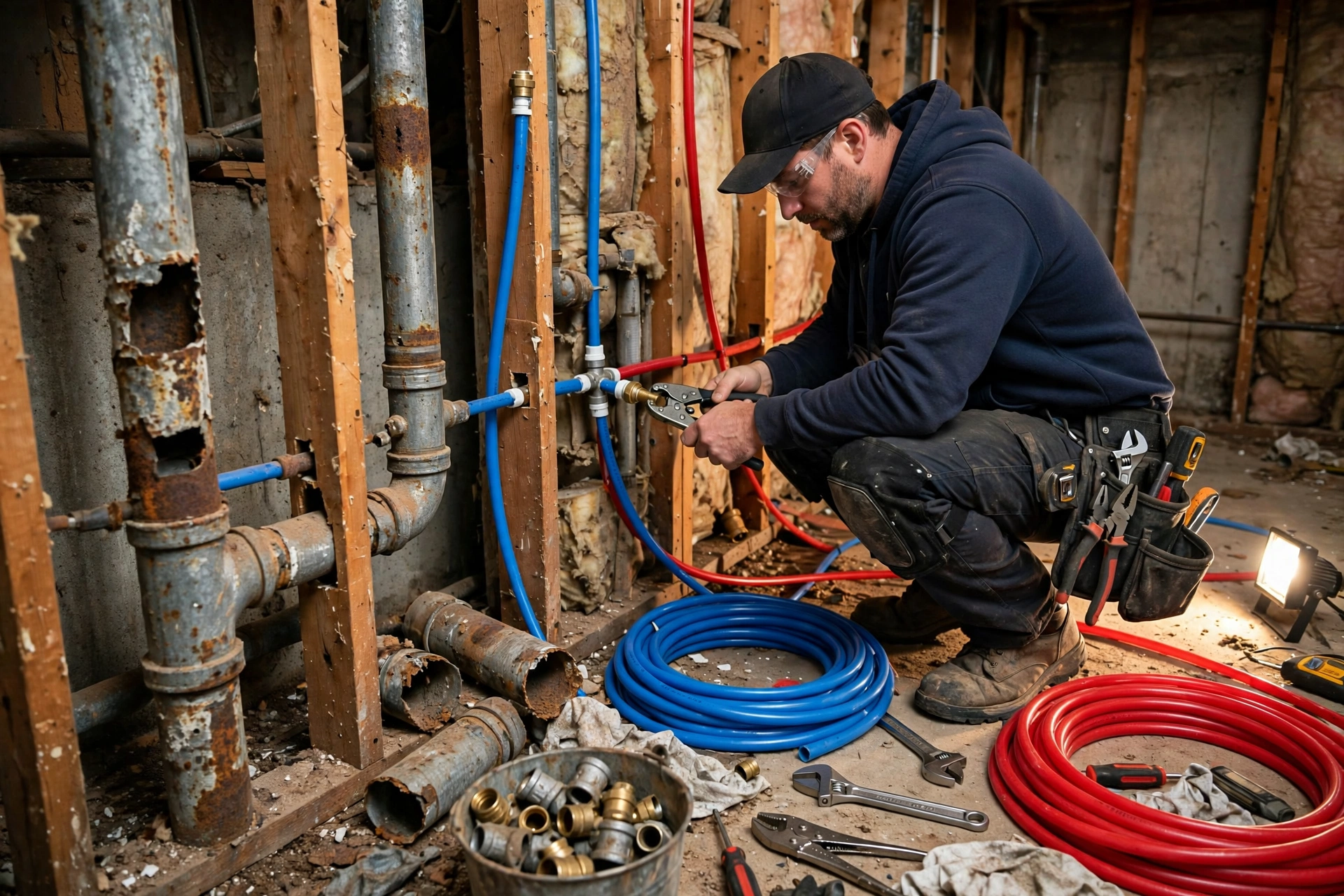
Many Friendswood homes built before the 1990s still carry galvanized steel supply lines. Galvanized pipe was never meant to last 50-plus years; the zinc coating erodes from the inside, water flow shrinks as scale builds up, and the pipe eventually thins to the point of leaking. The U.S. Census Bureau's American Housing Survey data consistently shows that older housing stock carries more plumbing failure reports, and galvanized systems are the classic reason.
Galvanized pipe earned its reputation honestly; it was a genuine improvement over the lead and iron systems it replaced, and plenty of it served for 40 or more years. But the zinc coating was always a sacrificial layer, and once it is gone, the steel underneath corrodes from the inside out. You cannot see this happening, which is why declining water pressure and discolored water are often the first clues that the clock has run out.
Spot repairs make sense when the piping is otherwise in good shape: a single failed joint, one pinhole leak in an accessible location, or damage from a one-time event like a nail through a line. A spot repair is a small fraction of repiping cost and does not disturb walls beyond the repair area.
Repiping becomes the smarter move when leaks keep appearing in different locations (each new leak is a sign the system is failing everywhere, not just there), water pressure has dropped home-wide from interior scale buildup, water runs brown or rusty on first draw, or the home still has galvanized or polybutylene piping past its service life. Nationally, a whole-home repipe typically runs $4,000 to $15,000 depending on home size, pipe material, and access difficulty. Slab-on-grade homes like most of ours can run toward the middle of that range because routing new pipe often means going up and over through the attic.
The honest math: if you are paying for your second or third leak repair in two years, add those invoices up. Many homeowners find they were already halfway to a repipe before they ever decided. A repipe with modern PEX or copper also resets the clock for 40 to 50 years, which matters if you plan to stay in the home. Read more about what a repipe involves on our whole-home repiping page.
Drain clearing vs sewer line replacement
A slow or backed-up main drain is one of the most stressful plumbing failures, because the symptoms are dramatic and the fix can range from a few hundred dollars to five figures. Knowing which situation you are in starts with a camera inspection.
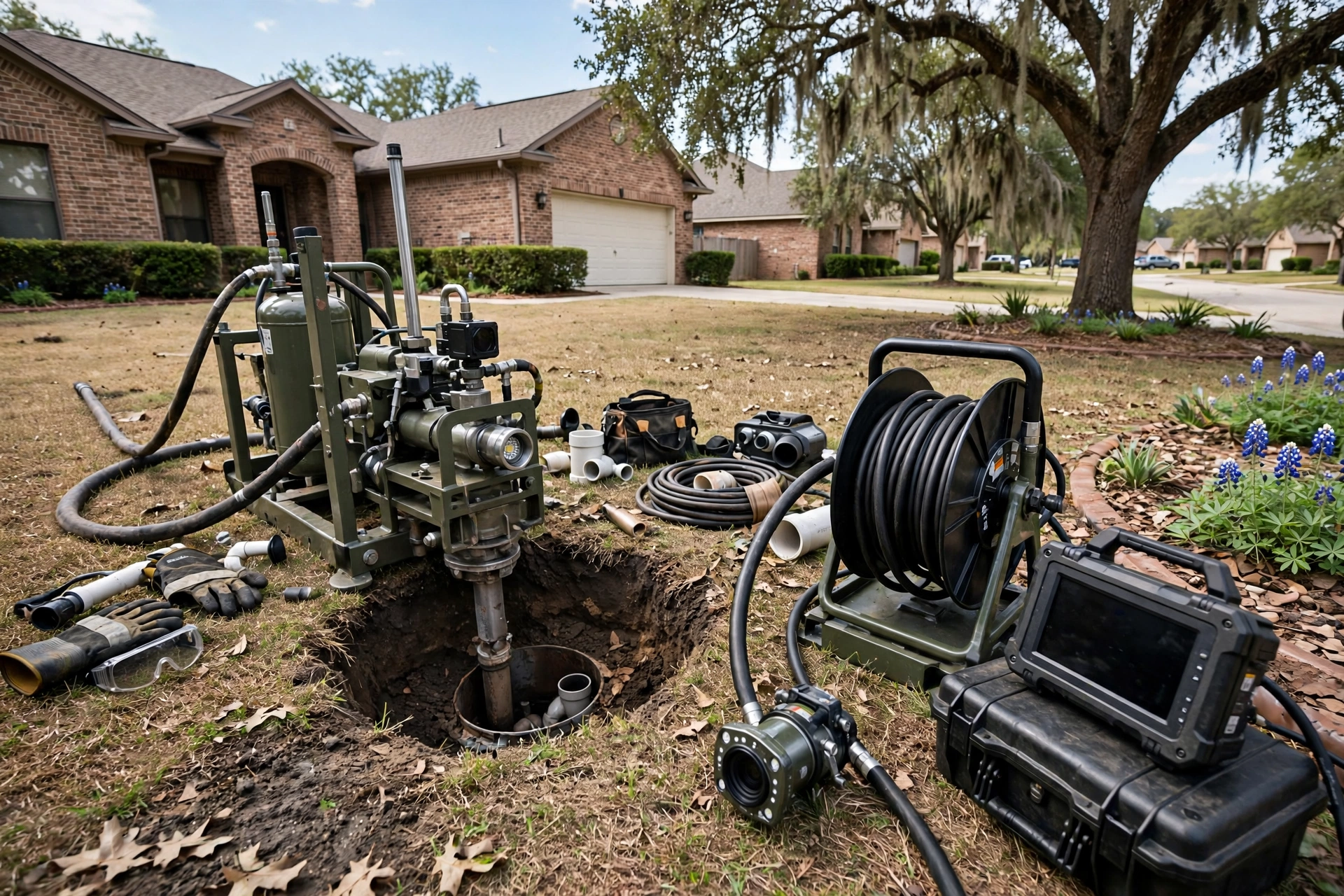
Routine clearing (snaking or hydro jetting) is the right answer when the line is structurally sound: grease buildup in kitchen lines, hair and soap in bathroom branches, or minor root intrusion that a good cleaning removes. Hydro jetting, which scours the line with high-pressure water, is more thorough than snaking and is often recommended for heavy grease or scale. Nationally, a main-line cleaning runs roughly $150 to $400, with hydro jetting toward the higher end.
Replacement or repair enters the picture when the camera shows a collapsed section, a severe offset or belly holding water, heavy root intrusion that keeps returning within months, or clay or cast iron pipe that is crumbling. Friendswood's clay soil is a real factor here: soil movement can shift and stress buried lines, and older clay tile sewers are especially vulnerable to root penetration at the joints.
Trenchless methods have changed this decision for many homeowners. Pipe lining or pipe bursting can rehabilitate a failing sewer without digging up the whole yard, typically at a lower total cost and with far less disruption than open-trench replacement. Nationally, trenchless sewer work typically runs $6,000 to $12,000, compared to traditional excavation that can exceed that once landscaping and concrete are restored. Not every line qualifies for trenchless, which is why the camera inspection comes first.
The repeat-offender test applies here too: if you are paying to clear the same main line twice a year, the cleaning money would have been better spent on a permanent fix. See our sewer line repair page for how camera inspections and trenchless options work.
Toilet and faucet repair vs new fixtures
Fixture decisions are usually the least stressful, but they still have a right answer. Most toilet and faucet problems are cheap to fix; the question is when cheap fixes stop making sense.
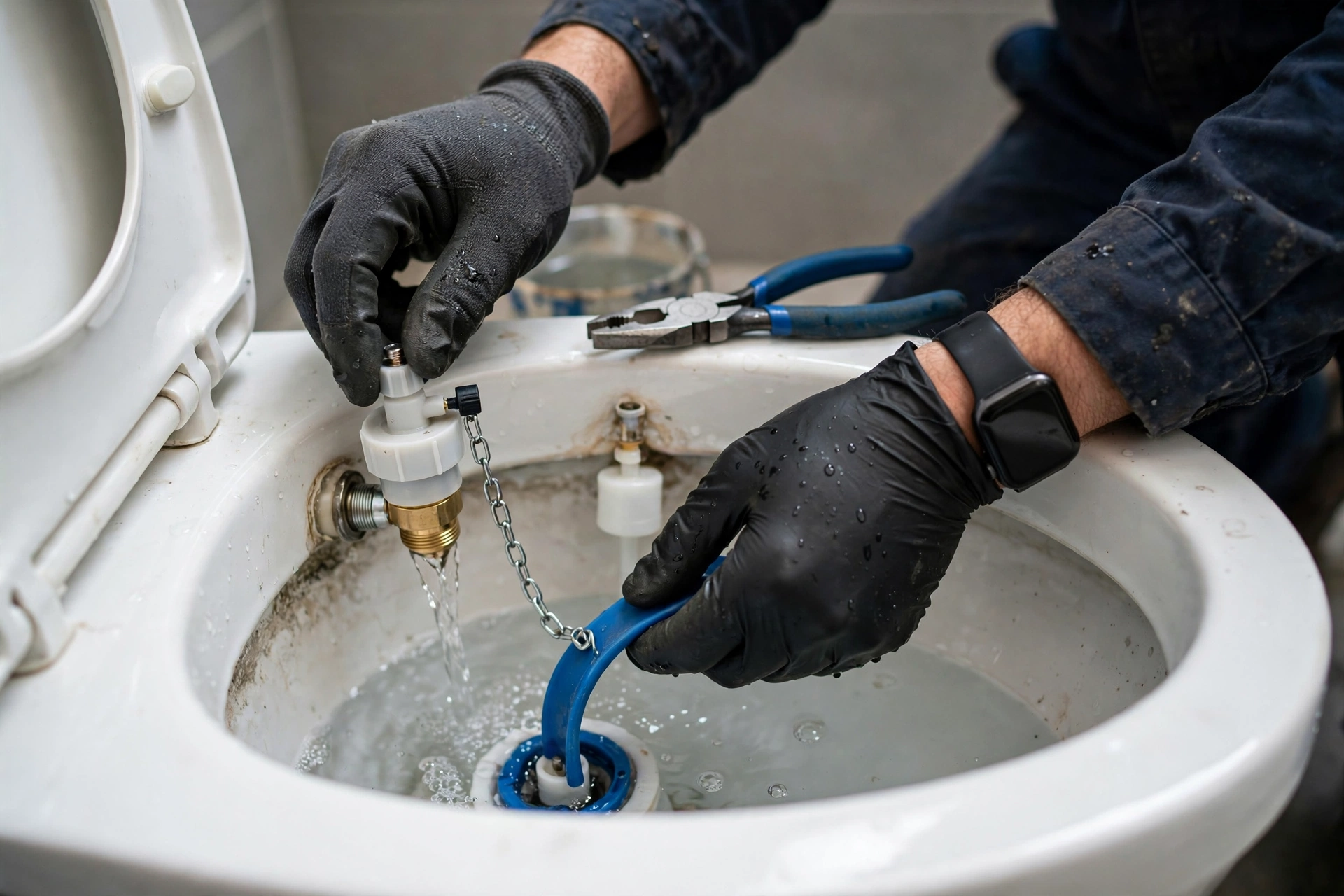
A running toilet is almost always a worn flapper or a misadjusted fill valve. Both are inexpensive parts and straightforward repairs, and there is rarely a reason to replace a toilet that otherwise works. The same goes for a dripping faucet: a new cartridge or set of washers usually restores it, at a cost far below a new fixture.
Replacement makes more sense when the toilet is a high-water-use model from the pre-1994 era (flushing 3.5 gallons or more per flush). The EPA's WaterSense program estimates that a modern WaterSense-labeled toilet uses 1.28 gallons per flush and can save thousands of gallons per year, which shows up on the water bill. Other replace signals: a cracked tank or bowl (cracks in porcelain are not repairable), persistent clogs in an old low-profile design, or a faucet with corroded valve seats where parts are no longer available.
Compression-style faucets, the older kind with separate hot and cold handles that you tighten down, use rubber washers that wear out every few years in hard water. Cartridge faucets, now standard in most mid-range and up fixtures, seal better and are easier to service. If you are replacing a faucet anyway, moving to a cartridge design with readily available replacement parts is a small upgrade that pays off in fewer drips down the road.
Hard water adds a Friendswood wrinkle. Mineral scale shortens the life of cartridges, aerators, and fill valves, so fixtures here may need small parts more often than the national average. A water softener or whole-home filtration can extend fixture life meaningfully, which is worth considering if you are replacing parts every year or two.
Slab leak repair options
Slab leaks deserve their own section because they are the signature plumbing problem of our area. When copper supply lines run under a concrete slab and the expansive clay soil moves, leaks develop that you cannot see, only hear about through symptoms: a warm spot on the floor, the sound of running water when nothing is on, a water bill that jumps for no reason, or damp baseboards.
There are three legitimate approaches, and the choice depends on the leak's location, the pipe's condition, and the home's age:
Spot repair: open the slab at the leak point, fix or replace the section, and patch the concrete. This is the least expensive option nationally, often $2,000 to $6,000 depending on access and restoration, and it makes sense for a first leak in an otherwise sound system.
Reroute: abandon the leaking line under the slab and run a new line overhead through walls or attic. This avoids opening the slab and is often preferred when the leak is in a difficult spot. It is a middle path in cost and disruption.
Whole-home repipe: when leaks keep appearing in different spots under the slab, the system is failing, not the section. Rerouting or repiping the whole home ends the cycle of slab leak, repair, repeat. Our slab leak repair page covers how detection pinpoints the leak before any concrete is touched.
The key step before choosing any of these is electronic leak detection. Cutting concrete without knowing the exact leak location is how small jobs become expensive ones.
Putting it together: a decision framework
When the next plumbing problem arrives, walk through these questions in order:
How old is it?
Past two-thirds of expected life means every repair is a short-term purchase. Water heaters 8 to 12 years, galvanized pipe 40 to 50, cast iron drains 50 to 75, fixtures 15 to 25.
What does the repair cost relative to replacement?
Over half the replacement cost on an aging unit usually favors replacement. Under a third on young equipment favors repair.
Is this the first problem or the latest one?
A pattern of failures is the system telling you it is done. One-off failures are what repairs are for.
Do local conditions accelerate wear?
Clay soil movement, hard water scale, and older housing stock all shorten effective lifespans here in Friendswood.
Real talk: the cheapest option today is not always the cheapest option over five years. Two more spot repairs plus water damage from a failed old tank costs more than one timely replacement.
One more practical point: get the repair quote and the replacement quote at the same visit, while the technician is already looking at the problem. Comparing a repair price from one company against a replacement price from another invites apples-to-oranges confusion. Written numbers, same scope, same day, make the decision obvious far more often than homeowners expect.
When you are unsure, get both numbers: the cost to repair and the cost to replace, in writing. A straight answer to that question is the minimum you should accept from anyone working on your home. That is how we approach it at Friendswood Plumbing Pros, and it is how you should expect to be treated by any plumber you call.
Repair vs replace FAQs
Should I repair my 12-year-old water heater or replace it?
At 12 years, a standard tank is past its typical lifespan, so replacement is usually the better investment unless the issue is a single inexpensive part and the tank itself is sound. A leaking tank always means replacement.
Is whole-home repiping worth it for a 1970s Friendswood home?
Often yes. Homes of that era typically have galvanized supply lines that are past their service life, and repeated leaks are a strong signal. A repipe resets the system for 40 to 50 years.
How do I know if my sewer line needs replacing instead of another cleaning?
A camera inspection is the deciding evidence. If it shows collapsed, offset, or severely root-damaged sections, or if you are clearing the same line multiple times a year, replacement or trenchless rehabilitation is the permanent fix.
Can a slab leak be fixed without breaking up the floor?
Sometimes. Rerouting the line overhead through walls or attic avoids opening the slab, and it is a common solution when the leak location makes spot repair difficult. Detection first, then you choose the method.
Are high-efficiency toilets worth replacing older models?
For pre-1994 toilets using 3.5 gallons or more per flush, a WaterSense-labeled 1.28-gallon model cuts water use substantially and can pay for itself through lower water bills over time.
Does hard water really shorten plumbing lifespan in Friendswood?
Yes. Mineral scale builds up inside water heaters, cartridges, and aerators, reducing efficiency and accelerating wear. Regular flushing and, in many homes, a softener or filtration system extends equipment life.
References
- EPA WaterSense. (n.d.). Toilets. U.S. Environmental Protection Agency. https://www.epa.gov/watersense/toilets
- HomeAdvisor. (n.d.). Water heater cost guides. https://www.homeadvisor.com/cost/plumbing/
- HomeAdvisor. (n.d.). Repipe cost guides. https://www.homeadvisor.com/cost/plumbing/repipe-a-house/
- Texas State Board of Plumbing Examiners. (n.d.). Consumer information. https://tsbpe.texas.gov/
- This Old House. (n.d.). Plumbing guides. https://www.thisoldhouse.com/plumbing/
- U.S. Census Bureau. (n.d.). American Housing Survey. https://www.census.gov/programs-surveys/ahs.html
- U.S. Department of Energy. (n.d.). Energy Saver: Water heating. https://www.energy.gov/energysaver/water-heating
Repair or replace? Get both numbers in writing.
Call Friendswood Plumbing Pros for a clear diagnosis and an honest comparison before you spend a dollar.
Call (281) 767-9387